Your bathroom is probably the most used room in the house — and, for a lot of Canterbury homeowners, one of the most underinvested. If yours still has the original avocado tiles or a showerhead that dribbles like a garden hose left on overnight, it might be time for a serious rethink.
Canterbury is one of Melbourne’s most sought-after inner-east suburbs, and homes here carry high expectations. Whether you’re in a federation era cottage off Maling Road or a newer townhouse near the Yarra, a beautifully renovated bathroom doesn’t just make your mornings better — it adds genuine, measurable value to your property.
But a bathroom renovation in Canterbury (or anywhere in Australia, for that matter) can feel overwhelming. Where do you start? How much should you budget? What materials last? Should you keep the bath or rip it out for a walk-in shower? These are the exact questions we’re going to answer in this guide.
At Select Kitchens Australia, we’ve worked with hundreds of Canterbury and inner-east Melbourne homeowners on both bathroom and kitchen renovations. We know what works, what to avoid, and how to get the most value from your renovation dollar. This 2026 guide pulls all of that knowledge together in one place.
By the end, you’ll know: what bathroom layout suits your home, what a realistic budget looks like right now, which materials offer the best bang for buck, what flooring to choose, how to plan the whole thing properly — and the top questions Canterbury homeowners ask us, answered straight.
Let’s get into it.
Bathroom Layout Types and Their Role in the Renovation Process
Before you start picking tiles or taps, you need to get the layout right. The layout of your bathroom will determine where your plumbing sits, how the space flows, and ultimately how much the whole thing costs. Getting this wrong early is one of the most expensive mistakes you can make — moving pipes is not cheap.
Here’s a breakdown of the most common bathroom layout types you’ll encounter in Canterbury homes:
Single-Line (Galley) Bathroom
All fixtures are arranged along one wall. This is common in older Canterbury terrace houses and smaller flats. It’s efficient and relatively cost-effective to renovate because plumbing is all in one run.
Best for: small spaces
Parallel (Double-Line) Layout
Fixtures on two opposing walls. Good for narrow but longer bathrooms. Allows for separate wet and dry zones, which is ideal for busy family bathrooms. Best for:
family bathrooms
L-Shaped Layout
Fixtures arranged around two adjacent walls. Excellent for corner shower placement and creates a natural separation between the vanity area and the shower or bath. Very popular in Canterbury renovations.
Best for: medium-sized rooms
U-Shaped Layout
Fixtures on three walls. Usually only practical in larger bathrooms, but allows for maximum storage and a luxurious feel. Often used in ensuite renovations.
Best for: large ensuites
Ensuite Layout
Smaller, connected directly to the master bedroom. Usually shower-only to save space. In Canterbury homes, these are often added during major renovations to boost resale value significantly.
Best for: master bedrooms
Costs of Bathroom Renovation: General Overview
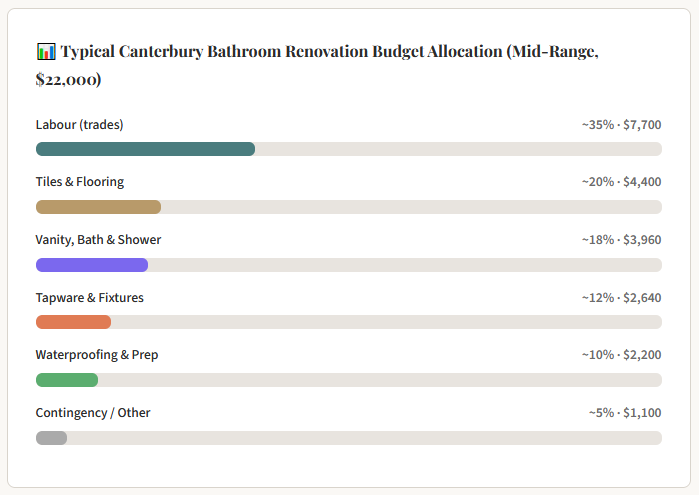
Let’s be straight with you: bathroom renovation costs in Canterbury and Melbourne’s inner east sit at a premium compared to outer suburbs. Tradies are in high demand here, and the quality expectations are higher. That said, with the right planning and the right team, you can get extraordinary results at every budget level.
Here’s a broad picture of what a bathroom renovation Canterbury project looks like in 2026:
| Renovation Tier | Typical Budget | What You Get |
|---|---|---|
| Budget | $8,000 – $14,000 | Like-for-like swap of fixtures, new tiles, basic vanity and tapware. Same layout, no structural changes. |
| Mid-Range | $15,000 – $25,000 | Full gut and redo with quality tiles, semi-custom vanity, good fixtures, new waterproofing and proper trades. |
| Premium | $25,000 – $40,000 | Designer tiles, custom joinery, freestanding bath, premium tapware, heated floors, full project management. |
| Luxury | $40,000+ | Architect-level design, bespoke everything, rare stone, smart home integration, full structural changes. |
| Canterbury Average (Mid-Range Full Reno) | ~$18,000 – $28,000 | |
Materials Costs Breakdown
Materials are where Canterbury homeowners have the most control over their budget. Choose wisely here and you can significantly elevate the look of your renovation without blowing out costs. Here’s what you’ll typically pay for key materials in Victoria in 2026:
Tiles
| Tile Type | Cost per m² | Notes |
|---|---|---|
| Ceramic (entry-level) | $20 – $45/m² | Durable, easy to clean, wide range of styles |
| Porcelain (standard) | $45 – $100/m² | More durable, less porous — ideal for wet areas |
| Porcelain (large format) | $80 – $180/m² | Very popular in Canterbury renovations; fewer grout lines |
| Natural stone (marble/travertine) | $150 – $400+/m² | Luxury look; requires sealing and more maintenance |
| Feature/mosaic tiles | $80 – $300/m² | Used as accents, niches, feature walls |
Vanity Units
| Vanity Type | Typical Cost (supply only) |
|---|---|
| Wall-hung flat-pack (budget) | $300 – $900 |
| Freestanding (mid-range) | $900 – $2,500 |
| Semi-custom (premium) | $2,500 – $5,000 |
| Custom-built joinery | $5,000 – $15,000+ |
Bathtubs
| Bath Type | Supply Cost |
|---|---|
| Acrylic drop-in (standard) | $400 – $1,200 |
| Freestanding (acrylic) | $1,200 – $3,500 |
| Freestanding (stone resin/cast iron) | $3,500 – $12,000+ |
Tapware & Accessories
| Item | Budget Range | Mid-Range | Premium |
|---|---|---|---|
| Basin mixer | $80–$200 | $200–$600 | $600–$2,000 |
| Shower set (head + rail) | $150–$350 | $350–$900 | $900–$3,000+ |
| Toilet suite | $300–$600 | $600–$1,500 | $1,500–$4,000 |
| Heated towel rail | $150–$350 | $350–$700 | $700–$2,000 |
Labour Costs Breakdown
Labour is typically your biggest single line item in a bathroom renovation Canterbury project. With the current trades shortage across Victoria, finding good people and paying them fairly is more important than ever. Trying to cut corners on labour almost always backfires.
Here’s what you can typically expect to pay for key trades in the Canterbury area in 2026:
| Trade | Hourly Rate | Typical Job Cost |
|---|---|---|
| Licensed Plumber | $120 – $180/hr | $2,500 – $8,000 (full bathroom) |
| Licensed Electrician | $110 – $170/hr | $800 – $2,500 (bathroom lighting, exhaust) |
| Tiler | $65 – $120/hr | $2,000 – $6,000 (full bathroom) |
| Builder / Carpenter | $90 – $150/hr | $1,500 – $5,000 (structural, framing) |
| Waterproofer (licensed) | $80 – $130/hr | $600 – $1,800 (full bathroom) |
| Plasterer | $70 – $110/hr | $500 – $1,500 |
| Painter | $60 – $100/hr | $400 – $1,200 |
| Total Labour (mid-range Canterbury bathroom) | $7,000 – $14,000 | |
What About a Bathroom Renovation Project Manager?
If you’re doing a mid-range to premium renovation and you’re not experienced in coordinating trades, it’s worth considering a renovation project manager or a company like Select Kitchens that handles the full process. Our project management service means you don’t have to chase plumbers, tilers, and electricians separately — we coordinate everything so your renovation runs on time and on budget.
Types of Flooring for Different Requirements
Bathroom flooring has to work harder than almost any floor in your home. It needs to be slip-resistant (especially wet), waterproof, durable, and look great for years. Here’s a rundown of the best options for Canterbury bathroom renovations in 2026:
Planning and Preparation for a Bathroom Renovation
Good planning is the difference between a renovation that runs on time and on budget and one that turns into a three-month nightmare. Here’s how to approach your bathroom renovation Canterbury project the right way:
Define Your Must-Haves vs Nice-to-Haves
Before you spend a dollar, write two lists: what the bathroom absolutely must have, and what you’d love if budget allows. This stops scope creep and helps your designer focus on what matters.
Measure Accurately and Draw the Existing Layout
Get accurate dimensions of your existing bathroom — length, width, ceiling height, and window/door positions. Note where existing plumbing waste outlets and water supply points are. This is critical for design and cost estimates.
Set a Realistic Budget with Contingency
Decide on your total budget and set aside 15–20% as a contingency. Don’t treat that contingency as spending money — it’s there for when you open up the wall and find a problem.
Check Council Requirements and Building Permits
Most like-for-like bathroom renovations in Victoria don’t require a building permit. However, if you’re changing the room’s footprint, moving walls, or adding a bathroom, you’ll likely need one. Check with your local Canterbury council or your builder.
Get Multiple Quotes from Licensed Trades
Always get at least 2–3 quotes. Check that all tradies are licensed (VCAT registered for builders, VBA-registered for plumbers and electricians). Don’t automatically choose the cheapest — ask for references and check their previous work.
Select Materials Early and Order in Advance
Tile and fixture lead times in Australia can stretch to 6–12 weeks for specialty items. Order everything before demolition starts so there are no delays mid-project.
Book Trades in the Right Sequence
Bathroom renovations follow a strict order: demolition → waterproofing inspection → framing/structural → rough plumbing → rough electrical → waterproofing → tiling → fit-off (vanity, fixtures, tapware) → final electrical → painting → accessories. Getting this order wrong can mean expensive rework.
Key Takeaways
A well-planned bathroom renovation Canterbury project can genuinely transform your daily life and add meaningful value to one of Melbourne’s most coveted property markets. Here’s what to keep in mind:
- Layout first: Don’t move plumbing unless you absolutely have to.
- Budget realistically: A quality mid-range reno in Canterbury sits around $18,000–$28,000 in 2026.
- Materials matter: Large-format porcelain tiles offer the best blend of look, durability and value.
- Don’t cut corners on trades: Proper waterproofing, licensed plumbers and electricians are non-negotiable.
- Plan before you pull anything apart: Good planning saves more money than any budget product ever will.
Ready to see what’s possible? The team at Select Kitchens Australia would love to help you create your dream bathroom in Canterbury.